
Ever feel like your bank benefits more from your money than you do?
You’re not alone.
While you may earn less than 1 percent on your savings, your bank is using your money to generate enormous profits.
Many people unknowingly allow banks to profit significantly from their deposits while receiving minimal returns. But it doesn’t have to be this way.
Let’s explore how retail banking really works and, more importantly, how you can turn the tables to ensure your personal finance strategy works for you.
How Banking Works
Fractional Banking
Most banks operate under a system called fractional reserve banking.
That means for every $100 you deposit, the bank is only required to keep a small portion (say 10%) in reserves. The rest can be lent or invested.
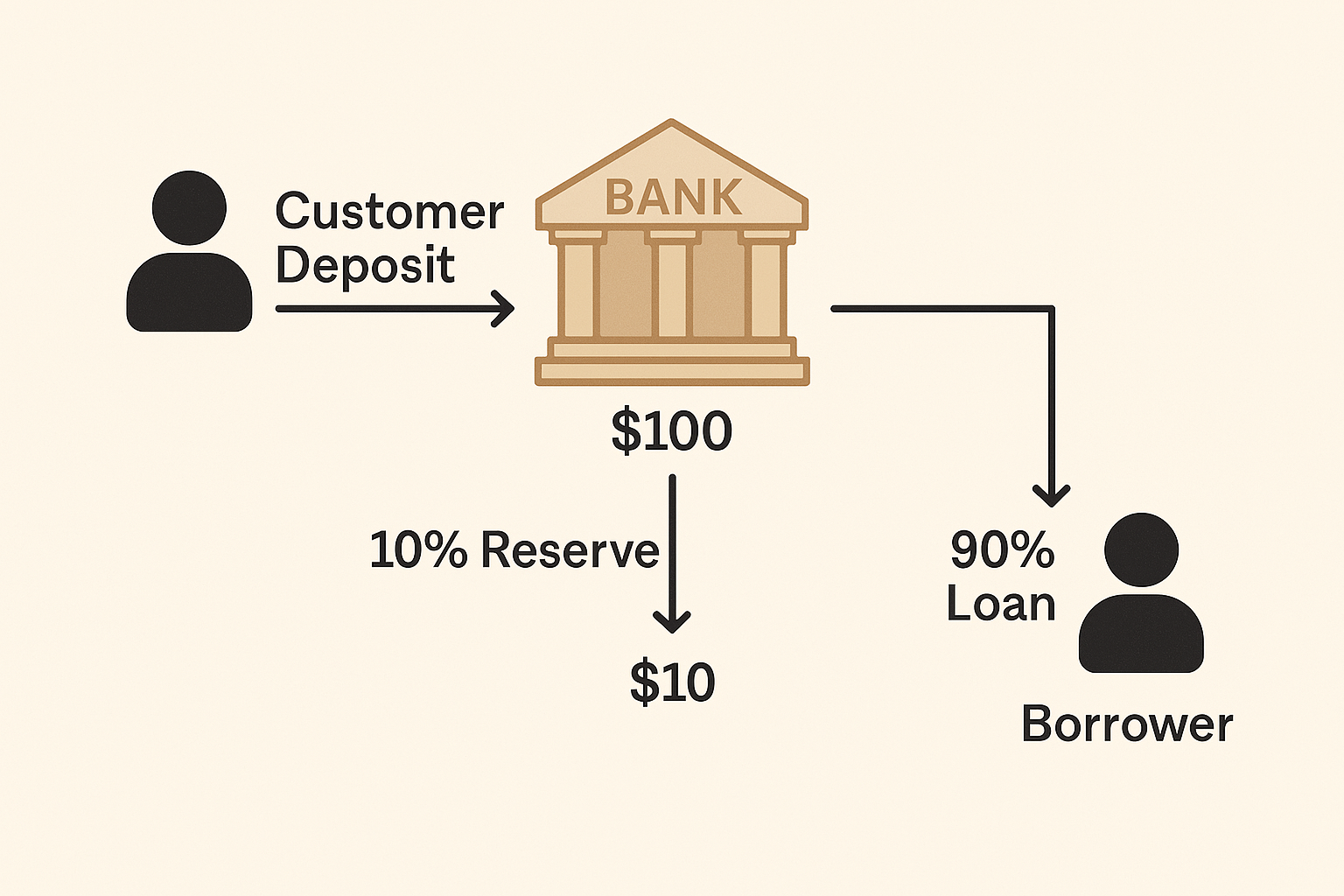
With a 10% reserve ratio, a single $100 deposit results in $1,000 being created through re-deposits and lending (known as the money multipler effect).
So if a bank has $1 million in customer deposits, it holds just $100,000 in reserves and lends the remaining $900,000. This eventually results in $10 million being created in the financial system.
Interest Margins
Banks operate on a simple principle: they use your deposits to fund loans and investments, charging borrowers higher interest rates than they pay you. This difference, known as the net interest margin, is a primary source of bank profits.
For instance, while your savings account might yield a mere 1% interest, the bank could be lending that same money at rates upwards of 5%. This substantial gap underscores how banks capitalize on your funds. Additionally, banks often impose various fees (maintenance charges, overdraft fees, and ATM fees) that further enhance their earnings at your expense.
You don’t have to opt out of banking, but you do need to reclaim control and make your money work harder for you.
Bank Account Options
Consider these factors:
- Low-Yield Accounts: A recent report highlighted that many Australians for example, are missing out on over $800 annually in potential interest earnings by sticking with low-interest savings accounts.
- High Bank Fees: Common fees, such as maintenance and overdraft charges, can erode your savings. For example, some banks charge monthly maintenance fees ranging from $5 to $25, which can often be waived by maintaining a minimum balance.
- Alternative Options: High-yield savings accounts, money market accounts (these combine features of savings and checking accounts), and certificates of deposit (CDs) offer significantly better returns compared to traditional savings accounts.
By understanding these dynamics, you can take proactively optimize your banking strategy.
Key Takeaways
To shift the balance in your favor:
- Research High-Yield Accounts: Seek out banks or credit unions offering competitive interest rates on savings. High-yield savings accounts can provide returns significantly higher than traditional accounts.
- Minimize Fees: Regularly review your bank statements to identify and avoid unnecessary fees. Opt for accounts with no or low maintenance fees and use in-network ATMs to sidestep withdrawal charges. You can negotiate with banks to waive fees.
- Diversify Your Savings: Explore alternatives like money market accounts or CDs, which may offer higher interest rates. Ensure these options align with your liquidity needs, financial goals and risk tolerance.
- Consider Credit Unions: These member-owned institutions often provide better interest rates and lower fees compared to traditional banks. Check their credit ratings and do your due diligence, and credit unions are generally smaller than banks.
- Stay Informed: Financial products and rates change frequently. Make it a habit to review your accounts and stay updated on better opportunities.
Your bank shouldn’t be the only one profiting from your hard-earned money. By being proactive and informed, you can flip the script, ensuring your finances grow to benefit you, not just the bank.
Small changes can lead to significant financial gains over time.
Here’s something to reflect on in the week ahead:
Review your bank statements and see how much bank fees you were charged in the last year. You may be surprised.
That’s all for this week.
See you next Friday.
– Jonathan M.
References
Investopedia. (n.d.). Net Interest Rate Spread: Definition and Use in Profit Analysis. Retrieved from
https://www.investopedia.com/terms/n/net-interest-rate-spread.asp
Investopedia. (n.d.). Fractional Reserve Banking: What It Means, How It Works. Retrieved from
https://www.investopedia.com/terms/f/fractionalreservebanking.asp
News.com.au. (2025). Simple act costing Aussies hundreds. Retrieved from
https://www.news.com.au/finance/markets/australian-dollar/how-one-change-could-pocket-aussies-800-a-year/news-story/7d68a2d3e9ab037772053a9e057ae4cf
Bank of America. (n.d.). 8 Common Bank Fees and Tips for How to Avoid Charges. Retrieved from
https://bettermoneyhabits.bankofamerica.com/en/personal-banking/avoid-bank-fees
NerdWallet. (2025). Best High-Yield Savings Accounts of April 2025: Up to 4.66%. Retrieved from
https://www.nerdwallet.com/best/banking/high-yield-online-savings-accounts
Synchrony. (2025). 5 Alternatives to Traditional Savings Accounts. Retrieved from
https://www.synchrony.com/blog/banking/traditional-savings-alternatives
FDIC. (2024). National Rates and Rate Caps – Weekly Update. Retrieved from
https://www.fdic.gov/resources/bankers/national-rates/
Disclaimer: This newsletter is general information only and is not financial advice. Always do your own research and consult a professional about your circumstances.
