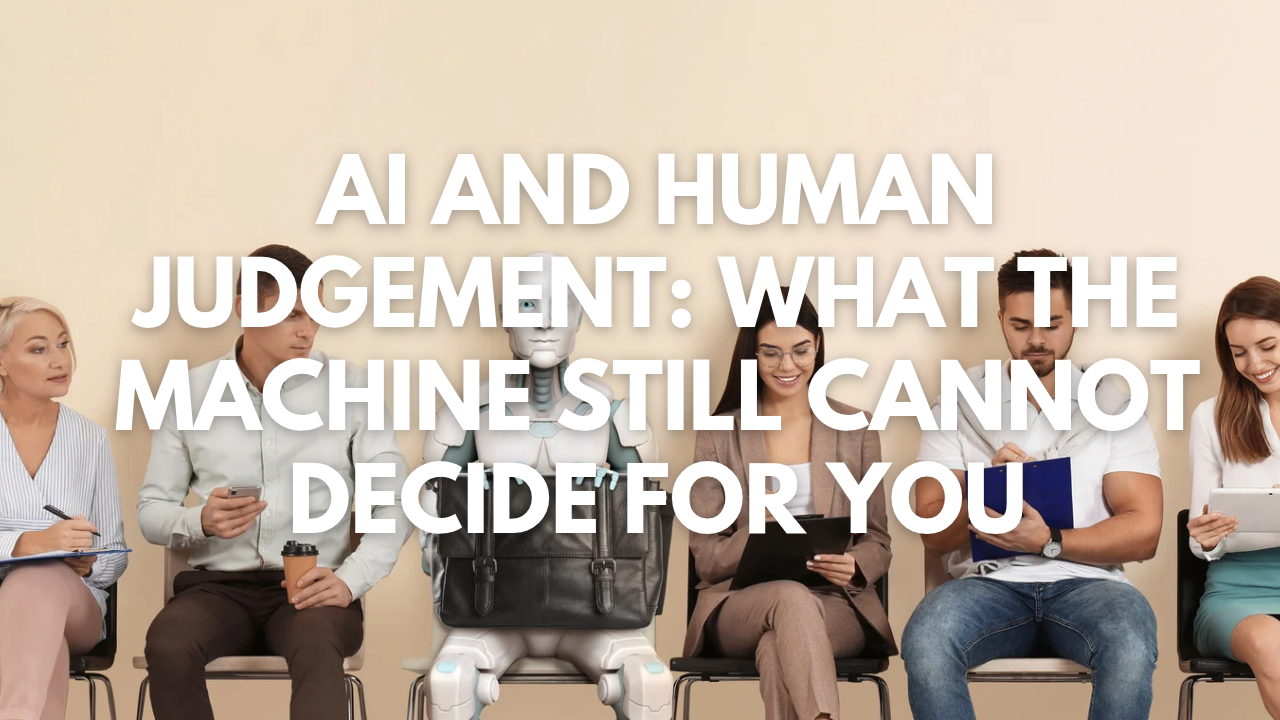
AI can analyse information, spot patterns and give you a convincing recommendation in seconds.
And that’s genuinely useful.
But here’s something worth thinking about.
Just because a machine can give you an answer doesn’t mean it can tell you what you should actually do.
Let’s say you’re running a business and considering expanding into a new market.
You ask AI to analyse the opportunity. It looks at the potential costs, compares the options and gives you a recommendation.
The numbers look good. The reasoning sounds sensible. On paper, it seems like a great move.
But what if your best employees are already stretched?
What if your cash flow is tighter than you’d like to admit?
Or what if this opportunity looks attractive, but pursuing it means taking your attention away from a problem that really needs fixing?
Suddenly, the decision isn’t quite as straightforward as the analysis makes it look.
And that’s where things get interesting.
Being intelligent and having good judgement are two different things
We tend to assume that if someone is intelligent, they’ll naturally make good decisions.
But we all know that isn’t always true.
You can understand the numbers, know your industry inside out and still make a decision you later regret.
Why?
Because understanding something and knowing what to do about it are two different things.
Intelligence helps you process information, recognise patterns and work through problems.
Judgement helps you decide what matters, what risks are worth taking and what you might be missing.
And this distinction matters when we start relying on AI.
A tool can compare two opportunities using the information you give it. But someone still needs to ask whether the assumptions make sense, whether the business can handle the risk and whether the opportunity is even worth pursuing in the first place.
Sometimes, the problem isn’t that you’ve got the wrong answer.
It’s that you’ve asked the wrong question.
The danger of an answer that sounds right
One thing I’ve noticed about AI is how easily it can make an answer sound convincing.
Everything is neatly organised. The reasoning flows. The recommendation feels logical.
And when you’re busy running a business, it’s tempting to look at that answer and think, “Right, that makes sense. Let’s go with it.”
But sounding right and being right aren’t the same thing.
An answer might be based on incomplete information. It might overlook an important assumption. The calculations could even be correct while the overall recommendation is wrong for your particular situation.
Think about it.
If you give AI the wrong assumptions, you shouldn’t be surprised when the conclusion leads you in the wrong direction.
The bigger concern is what happens next.
You take that answer into a meeting. Someone puts it in a presentation. The team starts planning around it.
And before long, something that was never properly checked becomes the basis for a real business decision.
The problem isn’t just that AI can make mistakes.
It’s that we can become so comfortable with its answers that we stop questioning them.
What does human judgement actually bring to the table?
Let’s go back to that business expansion.
Imagine two businesses looking at exactly the same opportunity.
The first has healthy cash reserves, a capable management team and a stable customer base.
The second is dealing with overdue invoices, stretched employees and a founder who’s already involved in every major decision.
On paper, the opportunity might look equally attractive to both businesses.
But would you recommend that they both move forward?
Probably not.
The second business might need to sort out its existing problems before taking on anything new.
That doesn’t necessarily make the opportunity bad. It means the timing might be wrong.
And timing matters.
Good judgement is about recognising things that don’t always show up clearly in a spreadsheet. It’s about understanding the circumstances, weighing the trade-offs and being honest about what you can and cannot take on.
Sometimes the right decision is to move forward.
Sometimes it’s to wait.
And sometimes it’s to walk away from an opportunity that looks good on paper.
Knowing the difference is what matters.
So, how should you actually use AI?
I’m not suggesting you stop using it.
Quite the opposite.
AI can be incredibly useful when you use it to improve your thinking rather than replace it.
Instead of asking it to make a decision for you, ask it to help you examine the decision more carefully.
Ask questions like:
“What assumptions am I making here?”
“What could go wrong with this approach?”
“What am I potentially overlooking?”
“What’s the strongest argument against my preferred option?”
These are much more useful questions than simply asking, “What should I do?”
Because now you’re not just looking for an answer. You’re trying to understand the problem better.
But don’t stop there.
Check the numbers. Verify the important information. Look at what the tool hasn’t been given. And, most importantly, be willing to disagree with the recommendation if it doesn’t fit your business.
AI can help you think through an opportunity.
It shouldn’t make you stop thinking about it.
The real advantage isn’t having more answers
Here’s what I think will become increasingly important as AI becomes part of everyday business.
Getting an answer is becoming easier.
Getting an answer has never been the same as making a good decision.
The real advantage will come from knowing which answers deserve your attention, which assumptions need challenging and when you have enough information to act.
You don’t need to reject AI to develop that ability.
You need to use it without becoming dependent on it.
So the next time AI gives you a recommendation that looks absolutely convincing, don’t just ask yourself whether the answer sounds right.
Ask yourself something else.
Do I understand this well enough to know whether it’s the right decision for my business?
Because the tool can give you an answer in seconds.
Knowing what that answer is actually worth? That’s still where your judgement comes in.